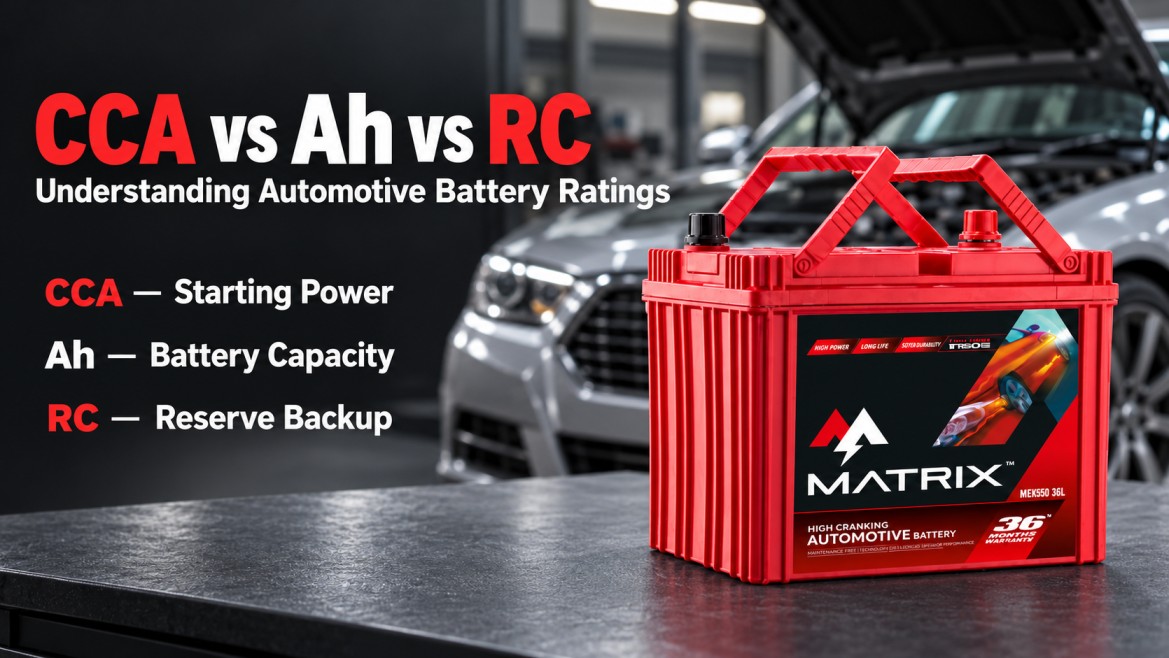
Automotive Battery Manufacturer in Hyderabad: Understanding CCA, Ah and Reserve Capacity

A car battery may be in top shape externally but find it hard to ignite the engine. However, this is mainly caused by selecting inappropriate battery specifications. Automotive Battery Manufacturer in Hyderabad supplies batteries that differ in their electrical specifications to fit different cars. It is important for the owners of vehicles and dealers to know CCA, Ah, and RC.

Why Battery Ratings Matter More Than Size ?

Even two car batteries which appear identical in size may give varying performance.

A little petrol-driven car and a commercial vehicle running on diesel may not require the same starting power. This is because the engines, the electrical system, and operating environment affect the choice of the battery used.

This is the reason why it is important to look at the label on the battery rather than buying one that can fit in the car.

What Is CCA in an Automotive Battery?

CCA stands for Cold Cranking Amps, which is the amount of current a battery in a fully charged condition can deliver for 30 seconds at -18°C without falling below a certain voltage level.

Hyderabad seldom sees such temperatures, but the measure is still relevant.

Why Is CCA Important?

Engine ignition requires high current for a short while.

A battery with a lower CCA rating may not perform well in starting the engine especially where the battery is old or the engine requires more force to start.

However, one does not need to choose batteries with the highest CCA ratings.

What Does Ah Mean in a Car Battery?

Ampere Hour (Ah): It gives an indication of the amount of electrical charge that can be delivered by the battery under the given conditions of discharge.

Thus, a 60Ah battery would be able to deliver 3 amperes for 20 hours under the given rated conditions of the battery.

Does Higher Ah Mean Better Starting?

Naturally not.

High value of Ah implies high charge capability, but the engine’s starting capacity also depends on the CCA and the overall condition of the battery.

It is necessary to consider both values when buying a new battery.

Understanding Reserve Capacity in Automotive Batteries

The Reserve Capacity (RC) of a battery measures how long a completely charged battery will maintain a 25 ampere output at about 27°C until it falls below a certain voltage level.

This is measured in units of time – minutes.

So a battery with a 100 minute reserve capacity will provide this load current for 100 minutes.

Why Does Reserve Capacity Matter?

Reserve capacity can be used as an indicator of the power storage capacity of a battery in case of the unavailability of the charging system.

Operating time, however, will depend on the electrical load and the battery itself.

This is not a guarantee that a car can keep running without any problem after alternator failure.

CCA vs Ah vs Reserve Capacity: Key Differences

Battery RatingWhat It MeasuresWhy It Matters
CCAStarting current at low temperatureEngine starting capability
AhElectrical charge capacityAvailable battery capacity
RCMinutes at a standard 25A loadReserve electrical supply

These three measurements describe different battery characteristics. They should be evaluated together with the vehicle manufacturer’s requirements.

How to Choose the Right Automotive Battery

Before you buy from an Automotive Battery Manufacturer in Hyderabad, ensure that the specifications of the required battery are known.

Consider the following:

  • Voltage required for the battery and its CCA
  • Ah of the battery recommended
  • Dimensions of the battery and the position of terminals
  • Charging compatibility of the battery with the vehicle
  • Battery warranty and its replacement terms

Start-stop vehicles require specific battery types such as AGM or EFB batteries.

Explore Automotive Battery Solutions From Matrix

Matrix Batteries produces automobile batteries for use in cars, tractors, and commercial automobiles.

Their range of automobile batteries features maintenance-free batteries that have been made using calcium alloy technology and are meant for cranking purposes.

One such battery is Matrix MXB900-41L, which has been provided with 90Ah rating. However, buyers need to inquire about CCA and reserve capacities separately since they are not the same.

Explore the Range of Matrix Automobile Batteries.

Frequently Asked Questions

1. What Is a Good CCA Rating for a Car Battery?

The correct CCA depends on the engine and vehicle specifications. Choose a battery meeting the manufacturer’s recommended starting-current requirement.

2. Is a 60Ah Battery Better Than a 45Ah Battery?

A 60Ah battery has a higher rated charge capacity, but suitability depends on the vehicle’s requirements, physical fit, and charging system.

3. Does Higher CCA Increase Battery Life?

Not directly. Battery life depends on charging conditions, temperature, construction, usage, and maintenance.

4. What Is the Difference Between Ah and Reserve Capacity?

Ah measures electrical charge capacity, while reserve capacity measures discharge duration under a standard 25A test load.

5. Does Hyderabad’s Hot Weather Affect Car Battery Performance?

Yes. High temperatures can accelerate battery ageing and water loss in applicable lead-acid designs, potentially reducing service life.

6. How Can I Select the Right Matrix Automotive Battery?

Check the vehicle manufacturer’s specifications and compare them with the selected Matrix model’s voltage, Ah, CCA, dimensions, and terminal configuration.

Conclusion

CCA, Ah, and Reserve Capacity give insights into the type of automotive battery you can use. They represent specific capabilities of the battery and none of them needs to be looked at individually.

When making decisions about which automotive batteries made by an Automotive Battery Manufacturer in Hyderabad are more appropriate, consider your vehicle first rather than higher ratings.

Check out automotive batteries made by Matrix.

Why Your Home Backup Requirement Changes Without You Noticing

An Inverter Battery Manufacturer in India can advise you about a battery that you should use according to your present load, but your load would be different after a certain time period. Your house would be having more loads after a few years, as more appliances are added in the load, and this has been done without increasing the capacity of the battery.

This causes the battery to become insufficient for the requirements of your house, although the capacity of the battery is not less.

Small Additions Slowly Increase The Load

Think about how a regular household develops through time.

Initially, the inverter would work for two fans, some lights, and one television. Next is the demand for WiFi. Then comes the demand for CCTV cameras. Someone begins working at home and purchases a computer. Now the house has the second television. It becomes necessary to charge more cell phones. One more fan is required in another room.

None of the above seem much by themselves, but together, they could make a huge difference to the total backup needs.

This means that it becomes very important that Inverter Battery Manufacturers in India should look at the total household load rather than just the battery age.

Backup Time Depends On What Is Running

Battery backup depends on the connected load.

Assume that one house runs two fans and three bulbs during the power outage. A second house has the same gadgets along with WiFi, CCTV, Laptop, and television as well.

Both houses have the same battery. The second house will get a lesser amount of battery backup than the first one.

This does not always imply that there is something wrong with the battery. Energy is just consumed quickly.

An Efficient Battery Manufacturer in India should assist the customer in realizing that backup time is not always a constant. It depends upon various factors.

Work-From-Home Has Changed Backup Needs

Not long ago, a backup system used to be limited to just providing backup to basic equipment during outages.

Nowadays, people cannot go without the internet and laptops at home.

A momentary outage can cause you to miss your meeting, classes, payment process, or telecommuting. Therefore, the inverter should operate under more loads than just fans and bulbs.

It is time to reconsider the battery capacity needed for your home.

Now, when your home relies on Wi-Fi, laptops, CCTV, and chargers every time there is an outage, the old backup system may not fit your needs anymore.

Before thinking about the problem being the battery, consider how much power you need now compared to before.

Larger TVs And More Electronics Add Up

Current houses have many more electronic items compared to houses a few years back.

Big screen TVs, satellite decoders, smart speakers, routers, gaming consoles, surveillance cameras, and several charging stations could all be drawing current from the inverter at once.

The amount of current used by any one particular item might not be much. But when several items are drawing current simultaneously, that is going to bring down the backup time.

For instance, having a TV, router, closed circuit television camera, and three mobile phone chargers powered up during a long blackout will consume considerable battery power.

The Inverter Must Also Keep Up

More weight impacts more than the battery backup.

It has to be capable enough to handle the appliances that are connected to it. In the event that there has been an increase in the home’s electrical load, but exceeds the capability of the inverter, then there may be problems such as beeping or shutting down.

Charging will come into play too.

In the situation where an increased amount of battery has been introduced into the system but the inverter charges at a slower rate, the battery will not be recharged enough for the next blackout.

The inverter, battery, and the load form one system.

Power-Cut Patterns May Have Changed Too

Sometimes, the house remains unchanged, but there are changes in the local power scenario.

A system that has been chosen for infrequent cuts of up to half an hour might seem to be insufficient in a situation where outages persist for two to three hours. Short outages might pose yet another problem, as the battery does not have sufficient time to charge itself before the next power cut.

That is the reason why Battery Manufacturer in India must take local outage scenarios into account before designing the backup.

The battery can behave totally differently, depending on the power cut pattern.

When Should You Recheck Your Backup Requirement?

It is worth considering the system when:

Several new devices are brought in

  • A person begins to work from home
  • CCTV or internet gadgets are included in the system
  • The backup duration decreases without a battery fault
  • The power outage becomes longer or more frequent
  • The inverter begins to give overload alarms

Family expects some other appliances to be kept running during an outage

A simple check-up of the load will usually help to identify the cause of the problem.

Matrix’s Approach To Home Backup

At Matrix Batteries, we consider home backup as a whole solution.

Battery capacity, inverter compatibility, charge period, connected load, and power outage pattern have to be taken into account. Being an Inverter Battery Manufacturer in India, it is necessary to choose the battery according to current home power usage rather than how your house consumed power a few years back.

A battery can still be working perfectly fine.

It might just require more from your home’s needs.

Final Thoughts

Home power requirements do not increase suddenly.

It is rather slow and gradual.

One router, one laptop, one additional fan, one CCTV camera system, and one bigger television may not mean a lot.

Together, they can affect the battery backup requirement.

Before changing the battery, evaluate the change in the household power requirements.

The ideal backup system is not one with the biggest battery. It is one with the right specifications for the current needs of the house.

Frequently Asked Questions

1. Why Has My Battery Backup Reduced Even Though The Battery Is Working?

Your connected load may have increased. Extra fans, Wi-Fi, CCTV, laptops, TVs, and chargers can reduce backup time.

2. Does Adding Wi-Fi And CCTV Affect Battery Backup?

Yes. Each device uses power, and several small loads together can noticeably reduce available backup.

3. Should I Buy A Bigger Battery If My Home Load Increases?

Not immediately. First check the inverter capacity, charging support, current battery condition, and actual load.

4. Can Work-From-Home Increase Inverter Battery Requirements?

Yes. Laptops, routers, monitors, and charging devices add to the load and may increase the backup requirement.

5. How Often Should I Review My Home Backup Setup?

Review it whenever you add major appliances, power cuts change, or backup time falls noticeably.

6. Why Choose Matrix As An Inverter Battery Manufacturer In India?

Matrix focuses on matching battery capacity with home load, inverter support, charging conditions, and real backup needs.