Best Inverter Battery Setup for Homes in India

Introduction

Most people think buying an inverter is enough. It is not. The inverter only converts power. The battery is what decides whether your home actually stays up during a cut.

This is why the ideal configuration of the inverter battery system for residential use in India cannot be achieved through the pursuit of maximum battery size or lowest costs. It involves the proper integration of the inverter, the type of battery used, the size of the battery, and even the installation environment according to the actual electrical demand of the household. The process begins with the load requirement, followed by backup time, type of battery, and then finally the brand of battery.

Start with the load, not the battery

This is where most people get it wrong. They ask, “Which battery should I buy?” before they even know what they want to run.

A better question is:

  • What appliances must stay on?
  • How many watts do they add up to?
  • How long do you need backup?

For a typical home, the essentials are usually fans, lights, Wi-Fi, maybe a TV, and in some cases a refrigerator. The actual inverter and battery size should be built around the total simultaneous load and the backup duration you want. That is the correct order.

Choose the battery type based on how you live

The big options are flooded lead-acid, VRLA or AGM-style lead-acid, and lithium-ion. They are not the same, and they do not behave the same.

Lead-acid batteries are mature, cost-effective, and widely used for standby backup. But they need more attention, and flooded versions need ventilation because hydrogen gas can build up during charging. That is not a small detail. It is a real safety issue.

Lithium-ion batteries are different. They offer high energy density, high efficiency, low self-discharge, and faster recharge behavior, but they cost more and require a more sophisticated battery management system. For homes that cycle the battery often, that usually makes them the cleaner long-term choice.

In simple terms

  • Lead-acid: lower upfront cost, more upkeep
  • Lithium-ion: higher upfront cost, cleaner daily experience
  • VRLA / AGM: a middle ground for easier home backup use

Size the battery properly

Battery size is where people either overspend or get stuck with weak backup.

A battery bank should be sized around:

  • daily energy demand
  • inverter system voltage
  • usable depth of discharge
  • desired autonomy or backup hours

Deep-cycle lead-acid batteries last longer if they are not discharged too deeply every time. In practical terms, battery life improves when the battery is cycled less aggressively. Lead-acid backup systems are usually happiest when they are used as standby systems, not abused like daily deep-cycle storage.

Heat and placement matter more than people admit

India is rough on batteries. Heat ages batteries faster, and bad placement makes it worse. That is not a theory problem. It is a real-world failure pattern. Temperature-related overheating can reduce battery lifespan, and poor thermal management increases the risk of faults.

This is why battery placement matters:

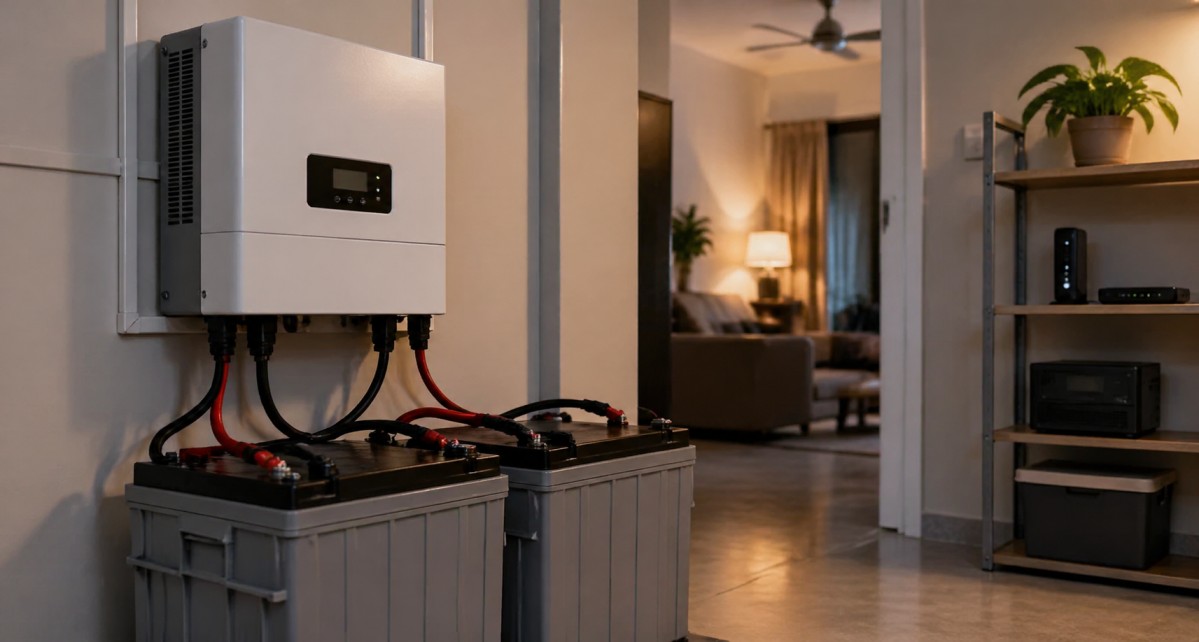
  • keep the unit in a ventilated area
  • do not trap it in a closed cabinet
  • keep it away from direct heat sources
  • do not ignore installer advice

Flooded lead-acid batteries especially need ventilation because they release hydrogen gas during charging.

A practical setup by home size

Small home

If the home only needs lights, fans, Wi-Fi, and a small TV, a compact setup is usually enough. The goal is not maximum power. The goal is dependable backup without overbuying.

Medium home

If the home has more fans, longer outages, or a refrigerator in the backup plan, the battery capacity needs to move up. This is where undersizing becomes obvious very quickly.

Large home

If the home runs multiple rooms, heavier loads, or wants longer backup with less maintenance, a better-sized battery bank or lithium setup makes more sense. Bigger homes also need more careful inverter matching so the system is not pushed too hard. System sizing guidance always starts from the load and backup hours, not from the battery label.

What makes a good inverter battery manufacturer

A reliable inverter battery manufacturer is not the one with the loudest marketing. It is the one that gets the basics right:

  • consistent build quality
  • stable charging and discharge behavior
  • proper thermal tolerance
  • strong after-sales support
  • batteries that last under Indian conditions

That is what matters in a real home. Not brochure language. Not vague claims. Consistency and durability matter more than flashy specs, especially when batteries are expected to perform in repeated backup cycles.

Where Matrix Batteries fits in

Matrix Batteries should be positioned as the brand that understands how Indian homes actually use backup power. That means building batteries for:

  • daily load changes
  • heat
  • long outage conditions
  • practical backup, not showroom numbers

The message should be simple: the right battery setup is the one that works when the lights go out and keeps working for years, not months.

Common mistakes people make

The usual mistakes are predictable:

  • buying on price alone
  • ignoring backup hours
  • choosing the wrong battery type
  • forgetting ventilation
  • installing in a hot or enclosed space
  • expecting one battery to handle too many appliances

Most bad backup experiences are design mistakes, not pure product failures.

Final take

The best inverter battery setup for homes in India is the one that fits the load, the backup need, the climate, and the battery chemistry. For most homes, that means starting with the actual appliances, choosing the right chemistry, and buying from a dependable inverter battery manufacturer that understands Indian conditions.

A good setup should feel invisible. It should just work.

And that is the point.
Best Bike Battery Manufacturer in India: What Sets the Top Brands Apart

Introduction

Most people don’t think about their bike battery until it fails. And when it does, it usually happens at the worst time. Early morning, you’re already late, ignition on… nothing. That’s when people start searching for the best bike battery manufacturer in India. Not for specs. Not for features. Just something that actually works when needed.

The problem is, most content online doesn’t reflect real usage. It talks about capacity and technology, but ignores how batteries behave in Indian conditions. That gap is exactly where most buying decisions go wrong.

What “Best” Actually Means in India

Forget marketing claims for a second.

In Indian riding conditions, a battery is “good” if:

  • It starts your bike consistently after sitting overnight
  • It doesn’t drain quickly in stop-and-go traffic
  • It survives heat without performance drop
  • It doesn’t give up within a year

A delivery rider in Delhi, for example, might start and stop their bike 40–60 times a day. That kind of usage destroys low-quality batteries fast. A casual rider using the bike twice a day won’t see the same wear.

So the “best” battery isn’t universal. It depends on usage. But the manufacturer quality is what determines how well it handles any scenario.

Factor 1: Internal Build Quality 

This is where the real difference lies.

Two batteries can look identical from the outside. Internally, they can be completely different.

Lower-end manufacturers often use:

  • thinner lead plates
  • inconsistent material composition
  • weaker separators

These batteries perform fine for a few months. Then:

  • starting becomes weaker
  • charge retention drops
  • lifespan shortens drastically

Better manufacturers focus on:

  • thicker, corrosion-resistant plates
  • uniform grid structure
  • stronger internal design

This is why one battery lasts 12 months and another crosses 3 years under similar usage.

Factor 2: Performance in Indian Conditions

India is tough on batteries. There’s no way around it.

Real conditions include:

  • 40°C+ heat in summers
  • humidity in coastal areas
  • constant braking and acceleration in traffic
  • irregular usage patterns

A bike left unused for 3–4 days in summer can already show weaker starting if the battery quality is poor.

Top-tier manufacturers design for:

  • heat resistance
  • vibration tolerance
  • stable discharge cycles

If a battery isn’t built for this, performance drops quickly, no matter what the label says.

Factor 3: Battery Type

Most buyers don’t even consider this properly.

Lead-Acid Batteries

  • Cheapest option
  • Works fine initially
  • Typical real-world life: ~12–24 months

AGM / Maintenance-Free Batteries

  • Better vibration resistance
  • Holds charge longer
  • Less maintenance

Lithium Batteries (still niche for bikes in India)

  • Lightweight and efficient
  • Expensive
  • Not always necessary for regular commuters

The mistake people make is assuming all batteries in a category perform the same. They don’t. The manufacturer’s quality control matters more than the type itself.

Factor 4: Consistency Across Units

This is something you only notice after experience.

With weaker brands:

  • First battery works fine
  • Second one fails early
  • Performance varies unit to unit

That’s not bad luck. That’s poor manufacturing consistency.

Reliable manufacturers maintain:

  • strict production standards
  • consistent material sourcing
  • uniform testing

This is why mechanics and dealers tend to trust certain brands over time.

Factor 5: Real Dealer Feedback

Online reviews can be misleading. Dealers see the real picture.

They deal with:

  • warranty claims
  • dead-on-arrival units
  • early failures

Ask any experienced mechanic, and they’ll quickly tell you:

  • which batteries come back often
  • which ones rarely cause issues

Low return rate = strong indicator of a good bike battery manufacturer in India.

Where Matrix Batteries Fits In

Matrix Batteries focuses on practical reliability rather than just spec-based marketing.

In real usage terms, that translates to:

  • stable starting performance even after idle days
  • durability in high-temperature environments
  • consistent output across different units

Instead of chasing only “high capacity” claims, the emphasis is on making batteries that hold up under everyday Indian riding conditions.

That’s what actually defines a dependable bike battery manufacturer in India.

Common Mistakes Buyers Make

  • Going for the cheapest option without considering lifespan
  • Ignoring riding pattern (daily vs occasional use)
  • Assuming all maintenance-free batteries perform the same
  • Not checking manufacturing consistency or dealer feedback

Most battery failures aren’t random. They come from these decisions.

Final Take

The best bike battery manufacturer in India isn’t the one with the most aggressive marketing or longest spec sheet.

It’s the one whose batteries:

  • start reliably every day
  • survive real Indian conditions
  • don’t degrade quickly under regular use

Because at the end of the day, performance isn’t judged in a showroom. It’s judged in that one moment when your bike either starts… or doesn’t.

FAQs

1. How do I actually pick a good bike battery manufacturer in India?

This can be done by considering practical reliability rather than promotional material. It would be wise to find out what the local mechanics suggest regarding reliable bikes and those that have few complaints or returns. In India, a reputable bicycle battery maker would be the one that produces batteries which last for two years or more.

2. Realistically, how long should a bike battery last?

In Indian conditions, most bike batteries last between 1.5 to 3 years depending on usage and quality. If your battery dies within a year, it’s usually due to poor manufacturing, excessive heat exposure, or irregular riding patterns like short trips that don’t allow proper charging.

3. Which battery type actually makes sense for daily use?

For everyday riders, maintenance-free batteries are usually the best option. They require minimal upkeep and perform well in traffic-heavy conditions. However, the manufacturer still matters more than the type, because build quality directly affects how long the battery holds charge and performs consistently.

4. Why do bike batteries seem to die faster in India?

Heat is a major factor, as it speeds up internal chemical wear. Add frequent stop-start traffic and irregular usage, and the battery rarely gets fully charged. Over time, this leads to faster degradation, especially in lower-quality batteries that aren’t designed for these conditions.

5. Is it worth paying more for a better battery?

In most cases, yes. Cheaper batteries often use lower-quality materials and tend to fail earlier, leading to more frequent replacements. Spending a bit more on a reliable option from a trusted bike battery manufacturer in India usually gives better lifespan and fewer issues over time.

What Distributors Should Look for in an Inverter Battery Manufacturer

The demand for inverter batteries has been increasing in recent years. They are used to power essential appliances in case of a power cut. The increasing demand for inverter batteries has made the distributors play a significant role in providing quality products to the market. The selection of the best inverter battery manufacturer is an important decision for distributors. The manufacturer selected will impact the distributor’s business growth. A reliable manufacturer will ensure the supply of products to the distributors and will provide better support to the dealers.

Matrix is one such company that works with distributors and dealers to provide inverter batteries to the market.

Product Quality and Reliability

The first factor that distributors should look at is the product quality. Durable and efficient batteries that can supply power for longer hours can help in building trust with consumers.

A reliable inverter battery manufacturer should have a focus on the longevity and reliability of their product. If the batteries are efficient, distributors can avoid problems with their customers.

Customers too prefer to stick with a brand that can provide efficient power during outages. Hence, product quality is a factor that distributors should look at.

Manufacturing Standards and Technology

Another important factor is the process of manufacturing adopted by the company. Companies that have adopted advanced techniques of manufacturing and quality checks are likely to provide better-quality products.

A good inverter battery manufacturer may incorporate quality checks at different stages of manufacturing. This ensures that the batteries being sent out to customers are of expected quality.

Manufacturers who have adopted innovation and advanced battery technologies are likely to help their distributors maintain competitiveness with rising customer expectations.

Consistent Supply and Distribution Support

Distributors depend heavily on regular product availability. Even if the product is selling well, inconsistent supply makes it difficult to maintain customer relationships.

Working with an inverter battery manufacturer that has consistent supply and efficient logistics can make a big difference. Consistent availability of stocks in hand enables distributors to meet customer demand without any delays.

Manufacturers such as Matrix focus on developing a network that helps dealers and ensures consistent availability.

Dealer Support and Business Opportunities

Beyond product supply, distributors also look for manufacturers that support their business growth.

Some important factors include:

  • Competitive pricing structures
  • Reasonable dealer margins
  • Warranty and service support
  • Marketing assistance

If manufacturers are supportive of their distributors, it would be easier for the dealers to promote and sell the product in the market.

Brand Reputation in the Market

Brand reputation can also play an important role in the purchasing decision of customers. Customers are more comfortable buying the product of a company that has a good reputation.

Distributors are always keen on working with an inverter battery manufacturer who has built trust with the market. It would be easier for the dealers to sell the product with a good reputation, and they can maintain long-term relationships with customers.

Conclusion

The selection of the appropriate manufacturing partner is another important aspect for distributors to ensure the establishment of a successful battery business. Quality of products, supply, manufacturing quality, and support to dealers are important aspects of the selection process.

Dealing with a reliable inverter battery manufacturer company enables distributors to provide quality products to the market, thus increasing their market presence. Companies such as Matrix continue to contribute to the industry by supporting dealers with supply and quality inverter battery products.

FAQ

Q1. Why is choosing the right inverter battery manufacturer important for distributors?

Choosing the right inverter battery manufacturer ensures consistent product quality, reliable supply, and better dealer support.

Q2. What factors should distributors consider before partnering with a battery manufacturer?

Distributors should evaluate product quality, manufacturing standards, supply consistency, and dealer support.

Q3. How does product quality affect inverter battery sales?

High-quality batteries build customer trust and lead to stronger brand loyalty and repeat sales.