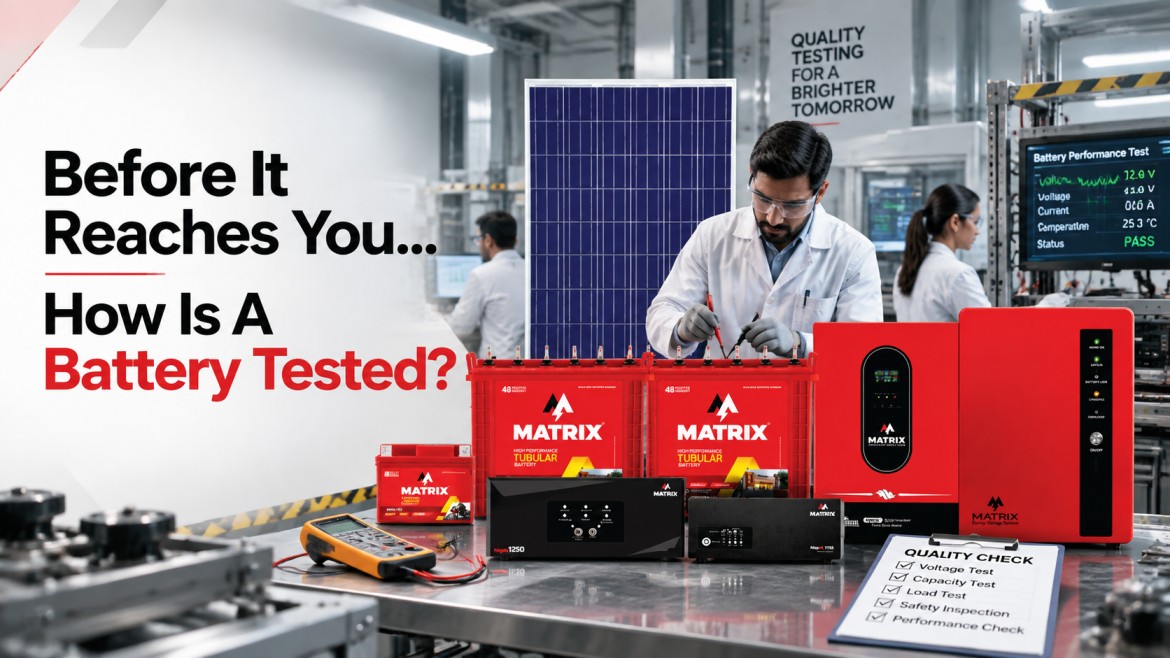
Battery Manufacturer In India cannot rely on the looks of a battery for making judgments about its quality. Prior to selling a battery to a customer or dealer, a manufacturer usually considers raw materials used, manufacturing quality, voltage level, charging performance, capacity, physical integrity, risk of leakage, terminals, and consistency of the battery. Different types of batteries require different tests to be done; however, there is always a common requirement – a battery should work properly right from the factory.
This information is important for both consumers and dealers. Batteries might seem pretty basic from the outside, but little variations in production can influence the performance of the battery.
Quality Testing Starts Before The Battery Is Complete
One of the initial stages of quality checking begins from the materials used for the battery.
There can be checks conducted on plates, separators, grids, terminals, material used for casing, active material and other parts depending upon the battery type. When there is inconsistency in the raw material, there will be a problem in making batteries consistently.
That is why a reliable Battery Manufacturer in India requires much more than a testing department. Quality control needs to start before the manufacturing process.
The company Matrix makes batteries for automotive use, two-wheelers, e-rickshaws, solar, and inverters. Since these products operate in various load conditions, product selection and material selection are not governed by one single formula.
Assembly Quality Matters More Than Buyers Can See
Even an apparently perfect battery can have poor assembly within.
In the process of manufacturing, the manufacturers must concentrate on alignment, fit of terminals, connections, sealing, case conditions, and positions of components. Poor assembly will lead to poor performance like failure to charge, loss of volts, overheating, and eventual premature breakdown.
Here, consistency in manufacturing comes in.
When ten pieces of the same kind of batteries roll off from the line, there is an expectation that all ten of them will perform the same way. The good manufacturer seeks to manufacture consistently rather than manufacture one good and many mediocre pieces.
This is especially so for those ordering in bulk.
Voltage Is One Of The First Electrical Checks
Voltage is an immediate way of knowing about battery health, but it does not speak everything about the battery.
The manufacturer may consider testing open circuit voltage along with battery behavior to determine whether the battery falls in the acceptable voltage range. If the voltage reading is not acceptable, the battery will require further testing.
But, an acceptable voltage reading cannot imply that the battery is an effective one.
The battery must demonstrate its capacity to deliver energy during operation.
Hence, it is important for a reputable Battery Manufacturer in Hyderabad to not judge batteries by their voltage readings alone. The test should take into consideration the behavior of the battery.
Capacity Testing Shows What The Battery Can Actually Deliver
Capacity is one of the major performance tests.
It is possible that a particular battery has a specified Ah rating, but the real issue lies in whether it can supply energy at the level close to its designed capacity during the particular test conditions assigned to that particular type of battery.
There are generally two steps involved in capacity testing, which include appropriate charging and discharging of the battery along with determination of its usable capacity.
This is important depending on the application of the battery.
The application of an automobile battery is different from that of an inverter battery and a two wheeler battery.
Hence, the testing procedure should be determined depending upon its application.
Charging Behaviour Can Reveal Hidden Problems
Charging is another aspect that manufacturers keep an eye on.
The battery must take the charge predictably. If it charges in a manner different from the one that was expected (it takes too much time, gets overheated, etc.), it may indicate a problem that requires investigation.
Manufacturers may analyze parameters such as the voltage increase, charging current, temperature behavior, and post-charging response.
It is essential for the cycle consideration since customers use batteries more than once.
They charge and discharge them repeatedly.
Thus, a Battery Manufacturer in India should consider the whole cycle, and not just the proper functioning of the battery straight after manufacturing.
Physical Inspection Still Matters
A test machine is not required for identifying all defects.
Visual inspection alone may indicate damage to the case, inadequate sealing, defective terminals, cracks, deformities, leaks, or any other evidence that the battery is unsuitable for further use.
The packaging and handling processes are important here as well.
Even an electrically qualified battery may end up being delivered to the customer in bad shape if it suffers damage before shipping.
Why Batch Consistency Matters For Dealers
One good example of the product is not what the dealer wants.
He/She wants the 50th unit to perform just as the first one did.
This is why batch uniformity becomes so important for a Battery Manufacturer in Hyderabad that sells to dealers/distributors.
If the product performs differently every time, there will be complaints, return of products, and time wasted in explaining issues to consumers.
Matrix itself brings into focus quality, reliability, and product uniformity in its brand positioning with regards to its batteries range.
Its automotive battery range explains particular aspects of materials used and construction, highlighting product design differences based on its application.
Final Inspection Is More Than A Last-Minute Check
Final inspection must synthesize all the previous tests.
Prior to shipment, manufacturers might test for electrical values, physical properties, terminal construction, markings, and model specifications. Why? Just to avoid the problem before the client does.
Quality control, however, does not end at one yes/no decision point.
The better way is to ensure quality from material, manufacture, testing, and final inspection.
This is how customers need to be served by a reputable Battery Manufacturer in India.
Matrix And Quality-Focused Manufacturing
Matrix describes itself as a battery maker for automobiles, cycles, e-rickshaws, solar, and inverter applications hailing from Telangana. This company emphasizes performance and innovation.
A customer comparing Battery Manufacturer in Hyderabad has to take into consideration that different applications require batteries differently.
Quality check thus has to answer not just one but several questions.
Is the battery functioning? Is it functioning according to the specifications of this application?
Frequently Asked Questions
1. What Do Battery Manufacturers Check During Quality Testing?
They may check raw materials, assembly, voltage, charging behaviour, capacity, terminals, casing condition, leakage risk, and final product consistency.
2. Is Voltage Testing Enough To Confirm Battery Quality?
No. Voltage is useful, but capacity, charging response, physical condition, and load performance also matter.
3. Why Is Capacity Testing Important?
Capacity testing helps confirm whether the battery can deliver the expected amount of usable energy under defined test conditions.
4. Why Does Batch Consistency Matter?
Dealers and customers expect the same model to deliver similar performance across different units. Good consistency helps reduce avoidable complaints.
5. Does Every Battery Type Use The Same Quality Tests?
No. Automotive, inverter, solar, bike, and e-rickshaw batteries have different operating needs. The test plan should match the application.
6. Why Choose Matrix As A Battery Manufacturer In Hyderabad?
Matrix offers batteries for several applications and positions its manufacturing around quality, reliability, and application-focused battery solutions.

